Thursday, November 23, 2017

Dealing with Workplace Ego Clashes


When egos clash in the workplace, owners and managers cannot afford to do nothing, because the business is likely to be the ultimate loser. So what is the best way to sort such problems out and why do they happen in the first place?

Ego clashes are nasty, destructive diseases that can harm businesses large and small. Many of us will have witnessed the symptoms. These can include one person deliberately failing to consult a colleague when they should, or failing to include them in group activity at work or after hours.
Sometimes warring factions ignore each other and in the process create an uncomfortable atmosphere for others. At other times they might clash or deliberately talk over each other in meetings. They might secretly seek to undermine their opponent to colleagues. Sometimes things can spill over and get ugly, leading to the unsightly spectacle of workplace shouting matches or worse.
Knowledge is power
Managing personality or ego clashes is something that businesses of all sizes can struggle with, but in small businesses owners may lack the knowledge or experience of how to sort out such problems," says Anthony Sutton, managing director of Lichfield-base which provides HR advice and support to SMEs.
"There isn't one answer to solving the problem; solutions are dictated by the personalities involved and circumstances, but good communication is vital," he stresses.
Regular, open conversations between the owner/manager and staff, during which issues can be raised, can prevent ego clashes happening or spiraling out of control. "An informal, 10-15 minute catch-up each week with staff can be enough," adds Sutton. "Ask employees open questions to find out how they're getting on and listen carefully.
But what if a serious ego clash has already taken place? "Don't ignore it - you must act," Sutton replies. "Explain to the employee or employees that you need to sit down with them and talk about what has happened. You need to listen to events from their perspective.
"Talk as little as possible - it's about allowing the employee to express their views. If the clash has been between you and them, take them aside and ask them why they believe things got to that stage. Avoid talking at them or telling them off - they'll simply get more frustrated or switch off," he warns.
Root of a problem
Sutton says such information is a gift that can enable owners/managers to get to the root of a problem, which can help to resolve any fall-out, prevent it happening again and enable everyone to move forward. "There might be deeper issues," he adds. "For example, an employee might feel unhappy, undervalued or that their opinions are ignored. You or others might have no idea they felt so strongly about an issue, while the cause of their anger or frustration might be wholly unintentional."
If the ego clash is between two employees, Sutton recommends discussing the problem with both individuals separately at first, but he says true resolution can only be gained by all parties meeting and agreeing a solution. "If people have been shouting at each other or ignoring each other, you must make it clear it's not acceptable, because it harms your business."
Differences of opinion are healthy in business, Sutton admits, but it's the way those differences are voiced or acted upon that often causes ego clashes. "If an impasse between two employees is reached, you, the manager, must ultimately make a judgment, and compromise may be required. You should fully explain your decision - which should always be made for sound business reasons.
Destructive influence
"Listening to staff is not a matter of being soft, while bullying them into doing what you want is no way to manage people. If your business is to succeed, your employees should enjoy their jobs and be able to make a valid contribution. People disagree - that's human nature, but differences of opinion can be discussed and resolved sensibly. Minor disagreements should never be allowed to fester or escalate, because ultimately it can prove highly destructive for your business," he concludes.

Friday, November 10, 2017

Think out of the Box Is Outdated

Whenever I hear someone say “think outside the box”, I start to wonder why there is a box in the first place. Personally, I don’t think inside the box, I don’t think outside the box, I don’t even know where the box is!We constrain our self when we box ourselves in. When we do this, we fail to see solutions outside of the status quo. If you have boxed yourself in… simply get rid of the box. For me, Lean Six Sigma helps to remove the box.Think of watching a movie in high definition (HD), can you recall what an image looked like prior to HD television? Similarly, looking at the world through the lens of a Lean Six Sigma Black Belt or Master Black Belt provides us a high-resolution and clear image of a problem.

Monday, September 25, 2017

How to Accept Where You Are and Move to the next Level


After witnessing so many (including yours truly) on the path of transformation, I have noticed there are developmental phases to personal growth. It’s important to know where we are in the process so we can:

1. Not have expectations to be further along and move into acceptance of where we are in our journey.

2. Understand the phase that is ahead of us so we have direction in terms of where we are headed.

3. Accept where other people are in their journey with more compassion and understanding.

**Note: every person is different, this is not a one-size-fits-all model but one I find fits many. You also may go back and repeat the phases when an expectation hangover triggers new awareness or new insights inspire new learning.**

Phase One: Asleep

Most of you reading this are either past or at the end of this phase because if you were asleep, you would not resonate with my work. So, yay! You are awake!! But I bet you remember being asleep when your old story, conditioning and fears ruled you. In this phase it is common for us to play the victim and believe we do not have the power or ability to change our own life. Blame, over-responsibility, fear, and lack of fulfillment are common when we are asleep. Then something happens and we move to stage two….

Terrible Loans You Should Avoid


We’ve all been taught that most types of debt are bad news. But some loans are such egregiously awful financial instruments, we think they deserve special mention.


There are some types of Loan one should avoid.  You’ll find they feature many things in common, such as exorbitant interest rates or various enticements to make you spend and borrow more. These loans so bad, you should only consider them as an absolute last resort.

1. The Payday Loan

Payday lenders present themselves as a friendly, helpful, and practical solution to running out of money before the end of the month. You’ve seen the claims on storefronts, and you’ve probably heard the commercials by now: “Money as soon as tomorrow!”

What payday lenders really are, according to Senator Elizabeth Warren, are “a credit product that can impose substantial costs on imperfectly informed and imperfectly rational borrowers.”

Warren decried payday lenders or cash advance companies in a paper “Making Credit Safer,” which noted that a typical $30 fee on a $200 loan amounted to a nearly 400% annual interest rate. These companies make 90% of their profit on customers who roll their loans over, paying again and again for the money they’ve borrowed.

Monday, September 4, 2017

Skills You Need to Thrive in Life


What does it take to thrive? A positive attitude? Well, sure, but that’s hardly enough. The Law of Attraction? The Secret? These ideas might act as spurs to action, but without the action itself, they don’t do much.
Success, however it’s defined, takes action, and taking good and appropriate action takes skills. Some of these skills (not enough, though) are taught in school (not well enough, either), others are taught on the job, and still others we learn from general life experience.
Below is a list of general skills that will help anyone get ahead in practically any field, from running a company to running a gardening club. Of course, there are skills specific to each field as well – but my concern here is with the skills that translate across disciplines, the ones that can be learned by anyone in any position.

1. Public Speaking

The ability to speak clearly, persuasively, and forcefully in front of an audience – whether an audience of 1 or of thousands – is one of the most important skills anyone can develop. People who are effective speakers come across as more comfortable with themselves, more confident, and more attractive to be around. Being able to speak effectively means you can sell anything – products, of course, but also ideas, ideologies, worldviews. And yourself – which means more opportunities for career advancement, bigger clients, or business funding.

2. Writing
Writing well offers many of the same advantages that speaking well offers: good writers are better at selling products, ideas, and themselves than poor writers. Learning to write well involves not just mastery of grammar but the development of the ability to organize one’s thoughts into a coherent form and target it to an audience in the most effective way possible. Given the huge amount of text generated by almost every transaction – from court briefs and legislation running into the thousands of pages to those foot-long receipts you get when you buy gum these days – a person who is a master of the written word can expect doors to open in just about every field.

Friday, August 25, 2017

What Leader Profile Are You?


A sense of real frustration had set in. The team wasn't meeting the expectations I had for them and not one team member seemed to be getting better. It felt as though we were stuck in quicksand with no relief in sight. So I did what most inexperienced leaders do, made changes on the team.

"Holding people accountable for their behavior is an act of love."

From the research survey results, five distinct leader profiles became evident depending on the levels of love and discipline a leader leveraged.

1. Exploiter
The exploiter at their core thinks about themselves before others. The idea of leadership being about serving and empowering others doesn't make sense to them until their team starts to rebel, and even then they just blame others. They rarely get maximum effort from their team. You could easily spot an exploiter if you looked at the browsing history of their team because it would be filled with glassdoor.com, monster.com or LinkedIn messages from recruiters.
Scores low in love and discipline
Rarely loved by their direct reports
Highly driven by financial success

2. Pleaser


The pleaser tends to avoid conflict at all costs and prefers the sensation of harmony. They rarely give constructive feedback or hold people accountable in fear they might upset those that they lead. Pleasers also tend to be okay with mediocre performance for an extended period of time.
Scores high in love, low in discipline.
May get taken advantage of by their direct reports.
Often passed over for promotions.
3. Ruler

Thursday, August 10, 2017

How to Pitch Your Idea to Investors in Minutes

As a young prospective entrepreneur without capital, you need investors to raise money to bring your idea to life. A good investment boosts your moral; it also gives you this extra motivation seeing that someone actually believes in you.
Also, if you wish that your idea/startup must live beyond you, seeking investments from outside source helps make this a possibility.
Another important reason we need investors is for growth. Maybe, you already have your business off the ground and it has been widely accepted, you need funds to grow the business so you can meet demands, beat competition and expand
How do you pitch your idea to an investor?
Anyone willing to invest has profit at the back of their minds. An individual investor wants his money to make more money in the nearest future, the government wants you to start making money so you can not only reduce the problem of unemployment but also to pay taxes when your business starts generating profits.
That being said, you need to prove to any investor that their money and time will not be a waste (wasted effort). First, you must be confident and believe in yourself.

Thursday, July 13, 2017

Creating A Personal Branding Plan in 30 Minutes


You're ready to make a career move—maybe you’re looking for a new job, launching a side business, or eyeing a promotion. In all of these instances, boosting your personal brand can help you achieve your goal.

That’s because a strong personal brand is a carefully designed message that’s compelling and attracts the right people. It helps you stand out for who you are and what you do best.

You’re probably nodding along, because you already know all of this. You don’t need to be convinced how valuable personal branding is: What’s holding you back is the time commitment.

That’s why you have a LinkedIn Profile, even though you haven’t updated it since you set it up. After all, who can devote hours each week on top of working or job searching? Well, believe it or not, 30 minutes is all you need to take your efforts to the next level. Here’s how to spend them:


Minutes 1-10: Evaluate What Makes You Stand Out

The first thing you want to do is perform a self-assessment. This step is often overlooked, but it’ll be super helpful as you find your voice in a sea of professionals with similar experience.

This evaluation helps you have a clear vision of your USP, or “unique selling proposition,” which is just a fancy term for the value you offer to your target audience.

Here are some questions to get you started:

1. What are you passionate about? You want to think about what excites you, and what things you truly enjoy doing.

2. What are your core beliefs? This is important because it’s like a mission statement. It’ll help you relay your personal approach to getting things done.

3. What are your top four strengths? This’ll help you share what you do better than anyone else, to set you apart from the competition.

4. Are you a good leader or a good doer—or both? This is good to know because it’s a way to identify and highlight the kind of roles that complement your strengths.

5. What do others say about you? Ask around! You may have strengths you’re unaware of, or talents you need to put more emphasis on so people know they exist.

To be clear, I don’t expect you to answer these questions with witty taglines. This exercise is to help you target your branding efforts. So, answer the question(s) that inspire you by jotting down notes, and honestly writing what comes to mind.


Minutes 10-20: Compare That to What You Already Have

Now that you’ve done some reflection on what you want to say, it’s time to see how it stacks up against what’s already out there.

If someone were to read your LinkedIn profile, tweets, or personal website, would they see messaging that points them toward the answers you came up with?

You might be thinking: Wait, I only have 10 minutes, that’s not enough time to read my whole website or review my LinkedIn line by line. But, here’s the thing, people who click into one of your social profiles or visit your website are probably going to spend a fraction of that time looking at it.

So, you want to look for things that shout what you do. On LinkedIn, that means moving beyond filling out the basics and adding links to media, writing posts, and getting endorsements for skills. On your website, that might mean building a portfolio. On Twitter, it’s about not just following influencers, but composing tweets, too.

This step is about comparing what you want to highlight to what you have and asking yourself: What’s missing? What can I add?


Minutes 20-30: Create a Schedule

Truth talk: Personal branding isn’t a “set it and forget it” kind of thing. Once you’ve figured out what you want your message to be and how you can share it more effectively, you’re going to need to start posting—consistently.

A helpful way to be consistent is to set a schedule that you can use as a guide. It shouldn’t feel like a chore, but if you’re anything like me, if you don’t schedule it, it could get back-burnered. All I ask is that you give it 10 minutes a day!

Here’s an example of a schedule you can start with:

  1. Monday: Make (or update) a list of people you’d like to engage with more (a former manager) or simply connect with (an industry influencer).
  2. Tuesday: Reach out to someone from that list. If it’s someone you’re reconnecting with, try one of these ideas. If it’s a stranger, you can test out this Twitter trick, or, if you’re brave, just send a cold LinkedIn invite using these templates.
  3. Wednesday: Spend time looking for industry-related articles in publications popular in your field and share one. Or, alternatively, comment on someone else’s post (or at a minimum, share it).
  4. Thursday: Make (or update) your list of improvements you’d like to make to your online presence. Break it down into baby steps. For example, you wouldn’t write, “Build personal site.” You’d write, “Look into site designers” and “write copy for personal site bio.”
  5. Friday: Spend today looking yesterday’s list and knocking just one thing off.

Of course, you can tailor your plan to whatever works best for you. Honestly, if you just do the five things above even once a month, you’ll see traction. Regardless of the schedule you choose, feel free to switch it up, and see what gets the best response. You won’t see results overnight, but, that’s OK.

My final piece of advice is to avoid being misled by the term “personal branding.” What I mean is: The most successful brands aren’t just about you. Take the time to know your target audience, and listening to what’s on their minds as well. Genuinely connect and build relationships! As best-selling author Dale Carnegie said, “To be interesting, be interested.”

Sunday, July 9, 2017

Have You Thought About Investing In Treasury Bills?


What is a treasury bill?

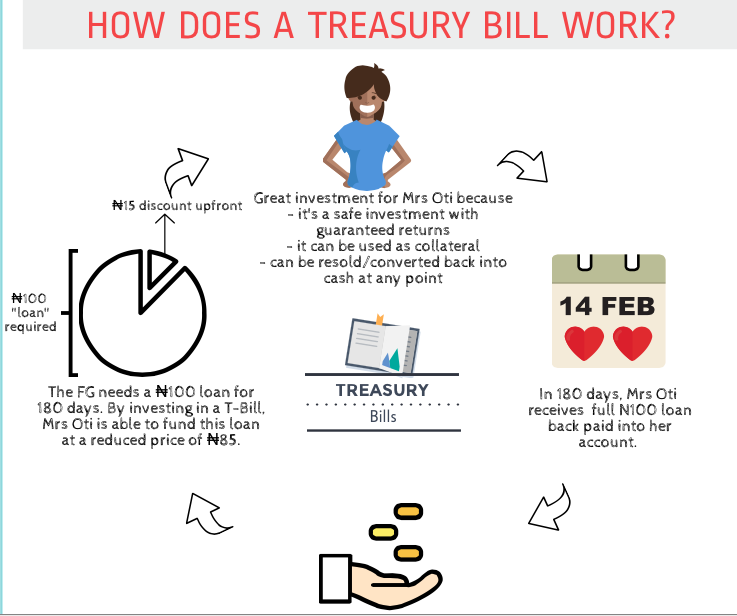
A Treasury bill (or T-Bill) is a short-term government debt security, which yields no interest. Rather, it is issued at a discount on the redemption price.

Basically, the Federal Government issues treasury bills at discounted prices for maturity periods between 91 and 364 days. At the end the selected maturity period, the government buys the bills back at full price. For example, let’s say you buy a 182-day ₦200,000 treasury bill at a discounted rate of ₦180,000. The Federal Government of Nigeria writes an IOU for ₦200,000 and agrees to pay back in 182 days. You don’t get any monthly interest payments, rather you make your money back when the bond is purchased back from you at full price. In this case the T-Bill pays 11% interest rate (₦20,000/₦180,000 = 11%) over the 182-day period.


Saturday, June 24, 2017

Speak Up for Yourself More (Without Becoming Unlikable)


A few years ago, I was tasked with creating a standard PowerPoint presentation that my company would use at a variety of trainings and conferences.

Needless to say, I was really putting my all into it, determined to prove that I could handle an assignment of this size. I was already up to my eyeballs in fonts and statistics when my boss dropped by my desk and said, “Turns out we need this presentation sooner than expected! Can you have it done by the end of the week?”

My internal monologue went a little something like this: “Absolutely not, you crazy person! Unless you expect me to live here, there’s no way I can get this done that far ahead of the original deadline.”

But, what came out of my mouth? Something along the lines of, “Absolutely! Not a problem.”

Following that dishonest exchange, I worked ridiculous hours to get that presentation wrapped up in time. I arrived early, ate lunches and dinners at my desk, and took work home with me late in the evening. It was torture.

Sigh. Can you relate? Have you put yourself in a similar situation because you didn’t want to stand firm and speak your mind?

You’re not alone. It’s tough to speak up and advocate for yourself, even when you know it’s important. None of us want to be viewed as unhelpful, uncooperative, or defiant. So, we grit our teeth and bear it—even when we know we should be standing up and saying something.

Fortunately, there’s a tactic that you can use to voice your concerns, opinions, and even disagreements—without seeming totally unlikable. It’s called “perspective-taking.”

The Secret Behind Breakthrough Innovations: The Power of Data Platforms for AI Success

  In 2006, a young engineer at a rising e-commerce startup noticed a glaring inefficiency. His company had an enormous amount of customer da...